

Wondering what the flags you see on the sand mean? The beach flag warning system uses colors to signal surf hazards: yellow is medium, red is high, and double red means the water is closed.
For the bigger picture, browse these water safety tips on staying safe in and around water.
| Item | Value |
|---|---|
| Yellow flag | Medium hazard |
| Red flag | High hazard |
| Double red flag | Water closed to public use |
| Purple flag | Marine pests present |
| International flag guidelines developed | 2004 |
| Florida enacted its flag system into law | 2005 |
These figures come from the Alabama Department of Public Health’s July 2024 guide and the South Walton Fire District’s beach safety page. Flag rules and local practice can change, so check the source before you rely on them.
Where the beach flag colors come from
Flags have been the go-to method for telling beachgoers about swimming conditions and hazards for decades. To make the signals consistent from beach to beach, the International Life Saving Federation (ILS) developed guidelines for flag usage in 2004, and the United States Lifesaving Association (USLA) has since endorsed and implemented them, according to the Alabama Department of Public Health’s July 2024 post.
Some states also write the system into law. Florida adopted and enacted its Beach Flag Warning System in 2005, and its flags are accompanied by interpretive signs along the beach that explain each color, as the South Walton Fire District describes.
What each flag color means
The core flags describe the overall surf hazard.
- Yellow: medium hazard. Moderate surf and/or currents are present, weak swimmers are discouraged from entering the water, and everyone else should use enhanced care and caution.
- Red: high hazard. Strong surf and/or currents are present, all swimmers are discouraged from entering, and anyone who does should take great care.
- Double red: the water is closed to public use.
- Purple: marine pests such as jellyfish or stingrays, which can cause minor injuries, are present. The flag is not intended to indicate sharks.
- Green: used in some areas to indicate calm or mild conditions, though it is not part of the ILS guidelines.
A purple flag does not describe the surf at all. Spectrum News reported in August 2025 that it can fly alongside any of the other colors, so a beach might show yellow and purple together.
The same report said that in Florida it is illegal to venture onto a beach that flies double red flags, as of its August 2025 publication. Rules differ by state, so check the local rules where you are.
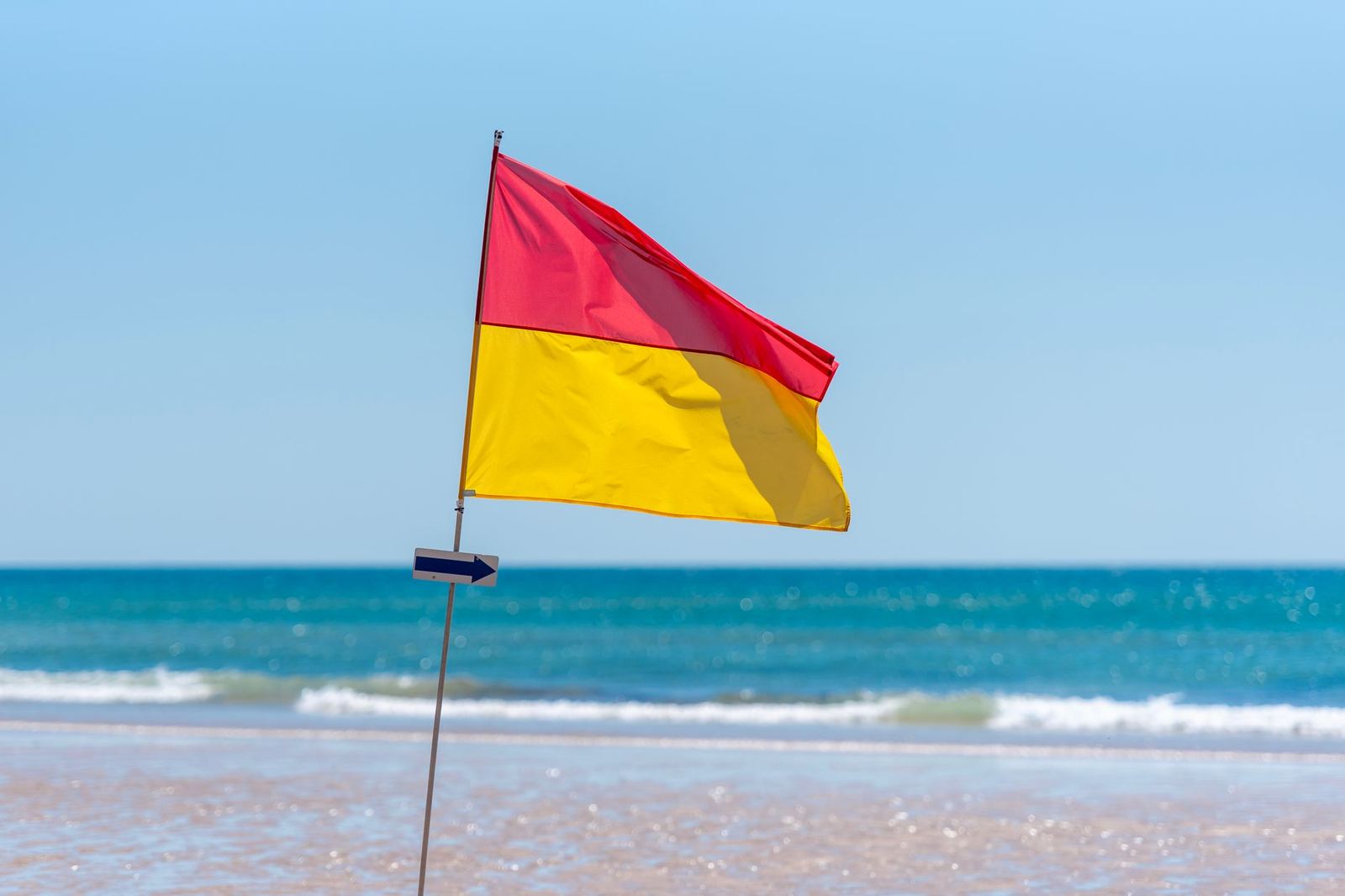
Flags for lifeguards, surfers and inflatables
Beyond the main hazard colors, the USLA definitions include several special-purpose flags. According to the same Alabama Department of Public Health post, they work like this:
- Red/yellow (halved red over yellow): the area is protected by lifeguards. A pair marks a supervised zone where swimming is permitted, and a single flag shows swimming is permitted in front of it.
- Red/white (quartered): emergency evacuation. Swimmers should leave the water, for example because of a dangerous marine creature, contaminated water or a search by lifeguards.
- Black/white (quartered): a zone used by surfboards and other non-powered watercraft.
- Yellow with a central black ball: surfboards and other non-powered watercraft are prohibited.
- Orange windsock: shows the direction of offshore winds and signals that it is unsafe to use inflatable objects in the water.
The USLA definitions are guidelines, and localities can use flags as they see fit. CBS News noted that purple or double red flags are sometimes used when sharks are present, so read the local signs.
Why the same flag can mean different things
The colors carry the same meaning wherever they fly, but the conditions behind them can differ. The Alabama Department of Public Health’s July 2024 post gives an example: what is thought of as a “medium” hazard at one beach might be considered a “high” hazard at another.
Flag choice can also be broader than the stretch of sand in front of you. In South Walton, flag colors are determined by the most dangerous surf or rip conditions within the county’s beaches, so the water where you stand may look calmer than the flag suggests.
Flags are also general surf warnings and do not specifically advise the public about rip currents. The same page says rip currents can give no visible indication from shore, and CBS News, in a report updated July 2, 2024, said they kill roughly 100 people every year in the U.S. To learn how they work and what to do if one pulls you out, read this guide to rip current safety.
What to do when there is no flag
Some beaches do not display flags at all. As of the Alabama Department of Public Health’s July 2024 post, the advice is not to assume conditions are safe but to check with local authorities for updates.
The same post points to the National Weather Service for resources on surf conditions, rip currents and overall beach safety. Swimming in a lake instead of the sea? The guide to lake swimming safety covers inland water.
A simple routine before you get wet:
- Look for the flag at the nearest lifeguard station or beach access, and read any signs beside it.
- Check what the color means under the local authorities’ guidelines.
- Look for a red/yellow flag, which marks an area protected by lifeguards.
- Ask lifeguards or local authorities if you are unsure or no flag is flying.
- Check local tourism, weather, government or municipal websites for advisories.
Frequently asked questions
Does a green flag mean the water is safe?
Show answer
No. Some areas use green to indicate calm or mild conditions, but the ILS leaves it out of its guidelines because it suggests conditions are completely safe, per the Alabama Department of Public Health’s July 2024 post. The ILS view is that a potential hazard is always present.
What does a purple flag mean?
Show answer
It means marine pests such as jellyfish or stingrays are present. The USLA says it is not intended to indicate sharks, though some places may use it differently, so check local signs.
Can you swim under a red flag?
Show answer
A red flag signals high hazard and discourages all swimmers from entering the water. Anyone who does should take great care. Double red is stricter, because the water is closed to public use.
What if there is no flag on the beach?
Show answer
Do not assume conditions are safe. Check with local authorities, and look at local tourism, weather or government websites for advisories.